Popular Posts

Showing posts with label Rantau Panjang-Sungai Golok. Show all posts

Tuesday, July 24, 2018

A tale of two towns

Rantau Panjang Town in the 1960s


                        A tale of two towns

By Wan Chwee Seng

Star 2 
Feb4 2017


As soon as dusk set in, we heard it, and our spirits sank. The distant blare of a horn was followed by a growing rumble, the screech of brakes and a stuttering hiss. The sound heralded the arrival of a train – the last train of the day to Rantau Panjang in Kelantan.


At the Rantau Panjang railway station

Pak Duk’s coffeeshop where we, teachers, stayed in the early 1960s was located strategically at one end of the town and was within sight of the railway station.
However, a clump of trees and a makeshift stall obscured it from our view. From our vantage point on the first floor of an open verandah, we watched forlornly as the train chugged past below us, rattling the iron bridge that straddled Sungai Golok before heading northward towards the Thai border town of Sungai Kolok.


The Rantau Panjang-Sungai Golok bridge


As it faded into the distance and disappeared in the gathering darkness, a deepening gloom descended upon the place. Rantau Panjang town then was still inaccessible by road and so the thought of our only physical link with the outside world being temporary severed, left us with a sinking feeling of being forgotten and forsaken.

During the day the local residents could cross over to the town of Sungai Kolok by using the narrow walkways that flanked the tracks of the railway bridge. An immigration post manned by one or two officers stood at Rantau Panjang’s end of the bridge and while local residents were usually allowed free access to Sungai Kolok, visitors needed border passes or other valid travel documents.

Sungai Golok, which formed a natural boundary between the two towns, also provided a convenient and expedient way of accessing both. Although it was illegal to cross the river by boat, shallow boats plied daily between the two towns.


Shallow boats plied between the two towns


Once the immigration post closed, murky figures could be seen creeping stealthily along the river bank. The border police had begun their nightly patrol of curbing illegal crossings and the rampant smuggling activities.

Without electricity, only the pale glow of oil lamps lit the town’s lonely stretch of unpaved road, while faint threads of light filtered through closed shutters of old wooden shophouses. Added to the gloom was the solemn stillness, broken only by the incessant chirping of crickets and the myriad sounds of other nocturnal insects.

Just across the waters, a nebulous glow lit the low night sky of Sungai Kolok town. The Thai border town had come alive. From the brightly neon-lit coffeeshops, the fragrance of fried noodles and the tantalising aroma of grilled chicken tingled the nostrils of food lovers, while the soft strains of ramvong beckoned the night-time revellers.

The residents of Rantau Panjang, meanwhile, were already getting ready for bed, as the town was virtually void of entertaiment, except for the occasional performance of the itinerant dikir barat troupe.


In the mid-1960s when the town was supplied with electricity, a makeshift theatre with plaited bamboo walls, palm-thatched roof and hard-beaten earth floor was constructed to cater to the entertainment needs of the local residents. Sitting on hard wooden benches, we would sometimes join the local audience to watch Hindi or Malay movies.

One morning, one of my pupils, Mohd Nor, approached me and said: “Sir, there is a good Elvis movie in Sungai Kolok.”
“I don’t think I want to see it, Mohd Nor. It is quite a far walk to the town,” I replied.
“It’s very near, Sir, if you go by boat. I can take you across in my father’s sampan.”
“Only 10 sen for the fare, Sir,” he said with a sparkle in his eyes.
Since I had not watched an English movie for some time and did not want to disappoint him, I finally agreed to his suggestion.

A weekend morning found Mohd Nor waiting for me at the river bank. He was soon paddling the boat confidently across the shallow water and within minutes we had reached the other side.
I paid him the fare and walked the short distance to the town centre. The theatre stood amidst a row of nondescript brick buildings, but it was easily discernable at a distance as a huge billboard with a hand-painted picture of Elvis Presley and the words “Jailhouse Rock” was prominently displayed in front of the theatre.

The moment I stepped into the theatre and my eyes adjusted to the dimly-lit hall, I noticed it was furnished with cushioned seats, while ceiling fans whirled overhead. The lights were switched off and the projectors came alive. I settled back to enjoy the show. Above the confused murmur of voices in English, a stentorian voice in Thai filled the hall.
“Must be an annoucement,” I thought to myself.
Then as the voice continued, it dawned on me that a narrator was giving a running commentary on the dialogue and action, and even romantic scenes were not spared from his comments. The continuous, monotonous narration was lulling me to sleep and I found myself sliding deeper into my seat. Fortunately, Elvis was given the liberty to render his songs without any interruption and so my eyes would snap open whenever Elvis’s voice came on.

It was mid-afternoon when the movie ended and as I had not made any prior arrangement with Mohd Nor for my return trip, I prepared myself for the long walk in the heat to the Sungai Golok bridge.
“Cikgu, want a ride to Rantau Panjang?” a voice behind me inquired in a deep Kelantanese accent.
I recognised the familiar figure of a trishaw rider from Rantau Panjang and the thought of the long walk made me accept his offer without hesitation.
The trishaw was soon gliding along the town’s well-paved asphalt road which ended at the edge of the town and then began to bounce along a bumpy dirt track pitted with potholes and flanked by tall grass.
A soft breeze ruffled my hair and my eyes flitted from side to side as I took in the vista. My movement must have caught the rider’s attention and perhaps thinking I was worried of being waylaid by armed robbers, he glanced at me and in an assuring voice said: “Cikgu, don’t be afraid. I have a pistol right under the passenger seat.”
Thereafter, whenever the trishaw hit a bump or swerved, I was more worried of the pistol going off than of being waylaid by robbers.
I was relieved when we finally reached the railway bridge. Then as I walked past the immigration post, I gave a cursory wave to the officer on duty, while my thoughts drifted to the still unused border pass, now frayed and discoloured, safely tucked away in my wallet.

Today, years on, whenever I think of my stint in Rantau Panjang, it brings back fond memories of a town that was once inaccessible by road and served by a steam locomotive.

Related article: Click below link

Warmth and kindness of kampung folks


Saturday, August 10, 2013

Rantau Panjang-Sungai Golok: Savouring past memories


Rantau Panjang - Sungai Golok:  Savouring past memories
By Wan Chwee Seng


The tantalising aroma of fried chicken rose from a sizzling wok  and drifted to a table where glasses of  ice-chilled syrup water were beginning to be coated with cold droplets. 

Ice-chilled syrup water

Around the marble-top table,  eight teachers sat waiting; waiting for the moment to begin their meal.

It was the holy month of Ramadan, in the early 1960s and four Muslim teachers and four non-Muslim teachers from the Rantau Panjang English school and the Malay school in Gual Periok were seated at a table in Ah Kong’s coffee shop which overlooked the town’s market square. 

Where Ah Kong's shop used to stand


Former market place, now a bus and taxi stand


 My three non-Muslim friends and I were in the company of our four Muslim friends who were waiting to break their fast. At the next table, a few customers too waited patiently. 

As we talked and laughed, we kept a discreet watch on  Hassan, our ‘tok imam’. Without T.V.  and radio  Hassan  had been entrusted with the task of determining the time for breaking  fast.  We watched and waited. From a  wooden wall came the slow measured ticking of a  clock; its minute hand seemingly stationary. Then we caught Hassan casting a glance at  the clock and when he lifted his hands in prayer, the other Muslim teachers followed suit, while the rest of us waited in respectful silence. The moment Hassan lifted the glass to his lips, it was a signal for us to begin our meal. 

Our evening meals at Ah Kong’s coffee shop was not limited to the month of Ramadan, but had become an almost  daily ritual. Every evening, as the sun began to set, the eight of us could be seen making our way along the single stretch of unpaved road from Pak Duk's shop where we stayed to Ah Kong's shop at the other end of the town.  


Rantau Panjang main road in the early 1960s, as I remember it


Rantau Panjang main road from old railway station to Lubok Setol


During the monsoon season, the laterite road was a slippery morass, pitted with potholes, but  during the dry spell it was baked dry by the scorching heat of the mid-April sun and the wind would send fine brown dust swirling into the evening air.

Once, on our way to Ah Kong’s shop we were walking past a clothes line when a gust of wind lifted it high into the air. When the  line rose higher, we realised the ’black line’  was swarm of flies that had settled closely on the clothes line. 

Ah Kong’s shop was also not spared from the flies seasonal invasion. Ah Kong would place a few thin broomsticks smeared with sugar-coated glue at strategic locations in the shop, but  the sticks would be magically transformed into thick black sticks.
 In spite of the flies, Ah Kong’s shop was well patronised by the locals as there were few eateries in Rantau Panjang  and the shop was relatively clean and served a fair selection of dishes.

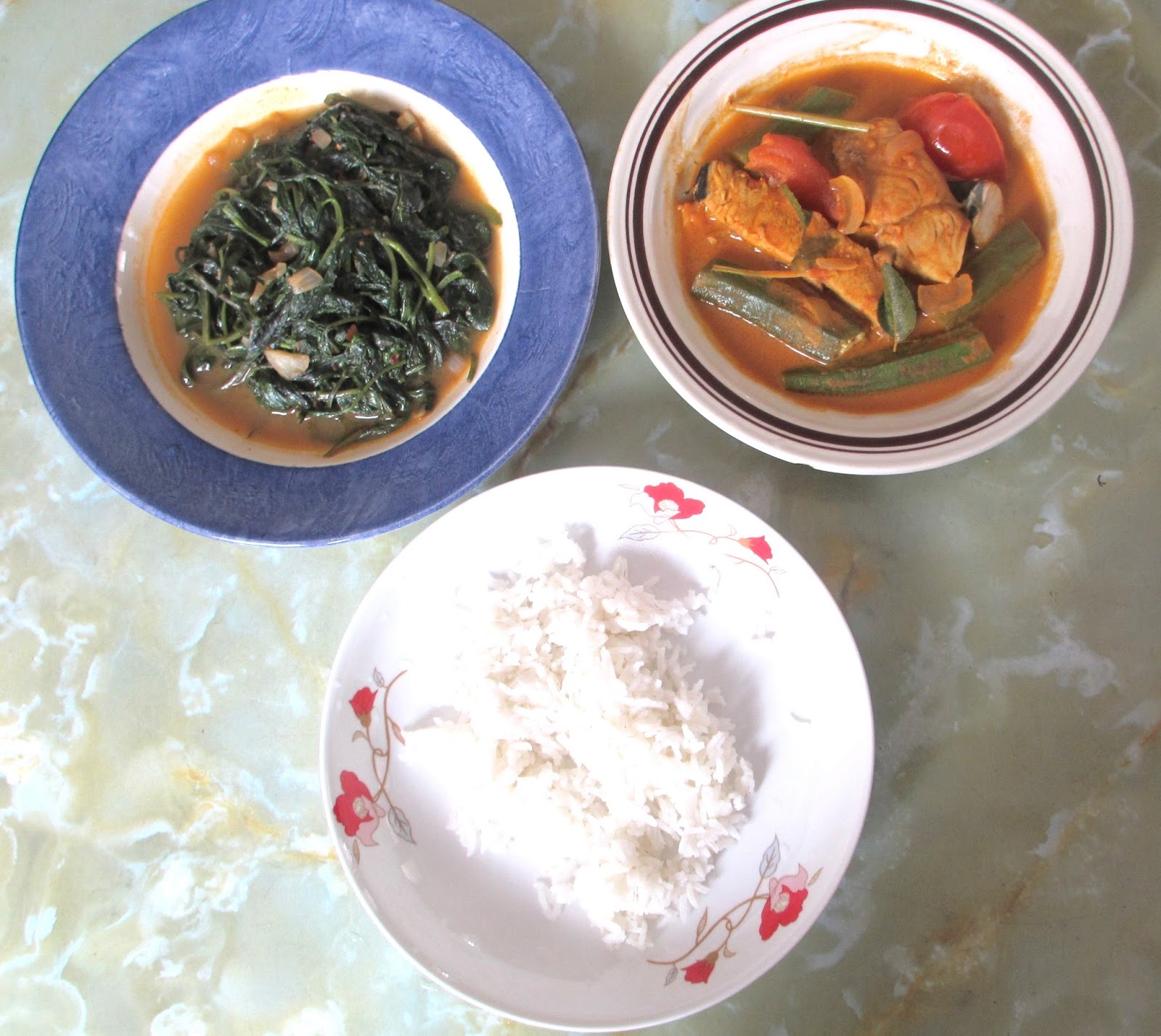
Whenever, we yearned for more spicy dish we would head for Syed’s shop which was located on the main road, close to the railway station. The moment we stepped into the shop, we just called out ‘makeh’ (eat) and took our seats at the table without even bothering to place our order. Unlike today's restaurants where diners are spoilt for choice, in Syed's shop we were left with no choice.  Everyday, Syed served the same food:  fish curry, fried kangkong and rice.

Fish curry, fried kangkong and rice


 Nonetheless, his fish curry was the best in town and we would take our time to savour every mouthful of the delicious dish.


An incident in the shop still remains vivid in my mind. One day we were having our meal in Syed’s shop when a voice interrupted our conversations.

“Satu, air sirup sejuk”."One cold syrup water."

We looked up to see a young immigration officer entering the shop. He must have just  been posted to the town, as we had not seen him before. 
He paused, looked around and continued,

Tolong, basuh air batu dengan air panas.” "Please, wash the ice with hot water."

We tried hard to suppress our smiles while from the corner of my eyes I could see the faint smile on Syed’s lips. I was not certain  if Syed followed his ludicrous request. Anyway, we knew the new city kid would soon learn to adapt to life in Rantau Panjang.

Today, as I look at the sumptuous spreads that is being readied for iftar at a posh restaurant in a  hotel, it brings back memories of the time when I used to accompany my Muslim friends to break fast in Ah Kong’s coffee shop.  It was just a simple fare, eaten in the austere setting of a small kampung shop ,yet after each meal  I could see the look of gratitude on their faces.
I have since lost contact of my Rantau Panjang friends, but  I will always cherish their friendship  _ a friendship  fostered through years of working, playing, eating together and living under the same roof.

Notes: Photos( taken in 2011) courtesy of Lt. Col.(Rtd.) Ojang Abdul Rahman

Sunday, September 20, 2009

Rantau Panjang - Sungai Golok: Bridge over Sungai Golok


The Star
Lifestyle
Oct.15th, 2007

Rantau Panjang-Sungai Golok: Bridge over Sungai Golok

By WAN CHWEE SENG


ONE morning I stood at the corridor of the double-storey rented house and gazed forlornly at the railway bridge that spanned Sungai Golok.
The bridge with its black iron girders now loomed dark and ominous against the breaking light of dawn.
The river was swollen with the previous night’s rain, its waters a raging torrent that swept away everything in its path. The morning reverie was broken by the sight of a boat laden with goods and passengers making its way under the bridge. The boatman had somehow misjudged the clearance height of the bridge because of the rising water.
The boat’s roof grazed one of the girders of the bridge and the boat keeled over. Goods and passengers were sent rolling and tumbling like ten pins over the side of the boat. They were quickly seized by the swirling water and swept downstream by the swift current.
Fortunately, most of those on board managed to swim to the banks, while others were rescued by the villagers. The morning incident somehow stirred the settled sediment of my memory of the first time I crossed the bridge.
I remember it was exactly a week after my arrival in Rantau Panjang in 1961. I was sipping thick black coffee in a shop when three elderly Chinese men in green uniforms strolled in. One was tall, the other was of medium height and the third man was stocky with a receding hairline.
Ah Kong, the proprietor of the coffee shop, introduced me to the three men who joined me for a drink. They said they were members of the border police force and their main duty was to patrol the Malaysian-Thai border and to help curb the rampant smuggling activities. Then Foo, the stocky man, said: 
Foo


“Cikgu, have you been to Golok?"
“No,” I replied.

“Like to go tomorrow morning?”
“Er? yes, but I have no border pass.” I replied hesitantly.
“No, problem,” he said with a broad grin.
The next morning, at the appointed time, Foo appeared at Ah Kong’s coffee shop with two bicycles.
“ Are we going to cycle across?” I asked anxiously.
“Yes,” he answered.
We cycled along the laterite road which had turned into a treacherous stretch after the monsoon rain and was now deeply furrowed by bicycle-wheel marks. When we reached the railway tracks, we dismounted and wheeled our bicycles along the slippery dirt track until we came to the bridge.
Foo waved to the immigration officer manning the post who waved back in acknowledgement. I thought it would be a breeze to cycle across the bridge. However, that thought quickly dissipated when I saw the bridge up close.

Railway tracks ran across the middle of the bridge, with narrow walkways on either side. The walkways consisted of iron strips with gaping holes between them. I pushed and guided the bicycle’s wheels along the strips while trying my best not to step into the holes.


Iron strips with gaping holes

Meanwhile, Foo was pushing his bicycle easily and steadily across the bridge; it was obvious that he had done this many times before. Below us, the river raged. The sight of it made my hands tremble.
We were halfway across the bridge when we heard a distant rumble.
“Hurry up! The train is coming!” yelled Foo.
The rumble grew louder and I could hear the long, shrill blare of the train’s horn.
The chilling sound made my hands tremble more and my legs seemed to buckle. I glanced round and saw that Foo had already reached the big circular pillar of the bridge and was well ensconced on top of it.
The rumble grew louder and the bridge beneath me started to rattle as if it was hit by an earthquake.
I finally made it to the pillar. Foo helped haul up the bicycle. I jumped onto the pillar in the nick of time as the train swept past me with a thunderous roar, sending a gust of wind which hit my face and body and almost threw me off-balance.
After I had regained my composure, we continued our journey across the bridge. I gave a big sigh of relief when we finally made it to the other side. We stopped at a roadside ice-kacang stall; I dug into the cool shaved ice, richly flavoured with thick syrup, to calm my frayed nerves.
We then proceeded to a Chinese restaurant where we shared a plate of char kuay teow. As we tucked into the savoury dish, the harrowing experience of the morning was soon forgotten.
Late that evening, when we went back the way we came, my steps were steadier. I had started out inexperienced and frightened but returned home a more self-assured man. From that short crossing, a friendship was forged. Foo helped me settle and adjust to my new environment and was always there to lend a helping hand.
A few months later, Foo left the border police force to join the Federal Reserve Unit. I lost touch with him for some time.
One day he appeared unexpectedly at my doorsteps. He had retired from the police force by then. He was still stocky and exuberant. But his hairline had receded further and his once sparse black hair now had streaks of white.
We had a drink at Ah Kong’s coffee shop.
“Like to go across?” I whispered out of earshot of the curious customers.
“Er? yes, but I have no border pass,” he replied with a bashful smile.
“No problem,” I assured him.
Later that day, we crossed the same old bridge that he had taken me across years ago. The bridge was a blurred and inconspicuous structure in the gathering darkness. I led the way while he followed with slow and cautious steps. Beneath us, the once raging water was a murky stream that meandered sluggishly between exposed sandbanks towards the distant sea.
We headed for the same restaurant and ordered a plate of fried kuay teow. As we picked at the strands of kuay teow with our chopsticks, we reminisced about the good old times.
Much water has since flowed under the bridge but I will always remember the experience of that first crossing and cherish the memory of the friendship it helped to foster.

Rantau Panjang-Sungai Golok: The magic of Syed


The Star
Lifestyle
Monday April 23, 2007

The Magic of Syed

Story and illustration
By WAN CHWEE SENG

Some characters from our past are so colourful that they live on in our hearts.

KELANTAN. The black handwritten word stood out boldly among the fine print, as I stared at the official letter in my hand. Thus, I was informed of my posting.
Having just returned from Kirkby College, England, after two years of teacher training, I had a week to spend with my family before reporting for work.
I remember boarding the train at Tampin, taking the night train at Gemas and reaching Kota Baru the next morning. A day later, I reported for work at the state education department. I was ushered into the Assistant State Education Officer’s office and was greeted by a kind, elderly Chinese gentleman.
“Young man, you have been assigned to a school in Rantau Panjang.”
“Rantau Panjang! Never heard of it.”
“It’s a nice place. Plenty of good food in the Siamese town across the border.”
Perhaps noticing my innocent and worried look, he said, “Never mind, see me in a year’s time if you’re not happy and I’ll transfer you to another school.”
The next day I boarded the train for Rantau Panjang and was met on arrival by the headmaster. After my luggage was bundled into a waiting trishaw, we headed for a nearby coffee shop.
On entering the shop, I noticed four elderly men seated round a marble top table. After a brief introduction, a dark and wiry old man said to me, “Cikgu, we are all parents of pupils in the school. You are free to cane our children if they’re naughty as long as you don’t break their heads or legs. See us if you have any problem.”
I was thus introduced to the infamous kapak (axe) gang of Rantau Panjang. Under their patronage and protection, I was able to move freely about town even into the wee hours of the morning.
One morning, a month after my arrival, I was in the midst of a lesson when I felt an air of excitement pervading the classroom. Pupils were casting furtive glances at the corridor. There was gentle shuffling of feet and a few raised buttocks. Curious, I glanced through the window and caught sight of a dark, bearded man who was bent double by the weight of an engorged knapsack on his back. A tightly rolled mengkuang mat was slung across one shoulder.
Silap mato,” whispered one boy. No wonder all the excitement, I thought to myself. Which child would not be excited by the visit of the occasional itinerant Indian magician? A few minutes later, I was called to the headmaster’s office.
“Wan, I want you to meet Syed who will be joining our staff.”
There was an air of despondency when I broke the news to the class. However, although there was no magic that day, Syed brought with him a different kind of magic – of joy and laughter – to the school.
Night comes quickly to this remote town. Except for the flickering yellow light of the oil lamps, the whole town would be enveloped in darkness. An eerie silence would descend. Syed, who had just come from the bright lights of the city, would pace the long corridor of the rented house like a caged animal.
Standing in the semi-dark corridor, he would gaze at the brightly-lit night sky across the border. A yearning for the bright light would then stir within him, like a moth in the dark recess of a house that is instinctively drawn to the light of an oil lamp.
One morning in school, after a nocturnal visit to the border town, he was overcome with drowsiness. After he had assigned some work to the class, Syed posted the monitor at the back of the classroom to warn him if he spotted the headmaster approaching the class. Then, he proceeded to place his folded arms on the table and rest his head in the crook of his arms. He was just about to slip into slumber when the monitor shouted, “Sir, sir, headmaster is coming!”
Syed jumped to his feet. Pointing a finger at the nearest boy, he barked, “Yes, you, what’s the answer?”
The poor innocent boy sprang up from his seat with his mouth wide open. There was, of course, no answer, as there had been no question!
Barring that particular incident, I remember Syed as a conscientious teacher whose presence brought fun and laughter in and out of the classroom, adding spice and colour to our otherwise mundane existence.
One day, after the mid-term break, Syed failed to report for duty. Sadly, we were to learn afterwards that he had met with an accident and had passed away. The pupils had lost a good teacher and ourselves, a good friend.
Even now, watching magicians perform their magic tricks on TV somehow stirs the still sediment of my memory. I recall with nostalgia my acquaintance with Syed Ahmad, and the day the “magician” came to Rantau Panjang.